
Programme outline · A shareable page

Build a new team's emotional culture from day one.

A six-week programme that helps a newly formed team design how they want to feel working together, and how they want their stakeholders to feel working with them. Then makes both visible, week by week.

42Days
EE
Measured with Wharton · Proven at Amazon

This exact programme was run with a brand-new Amazon team and measured by Professor Michael Parke at Wharton.

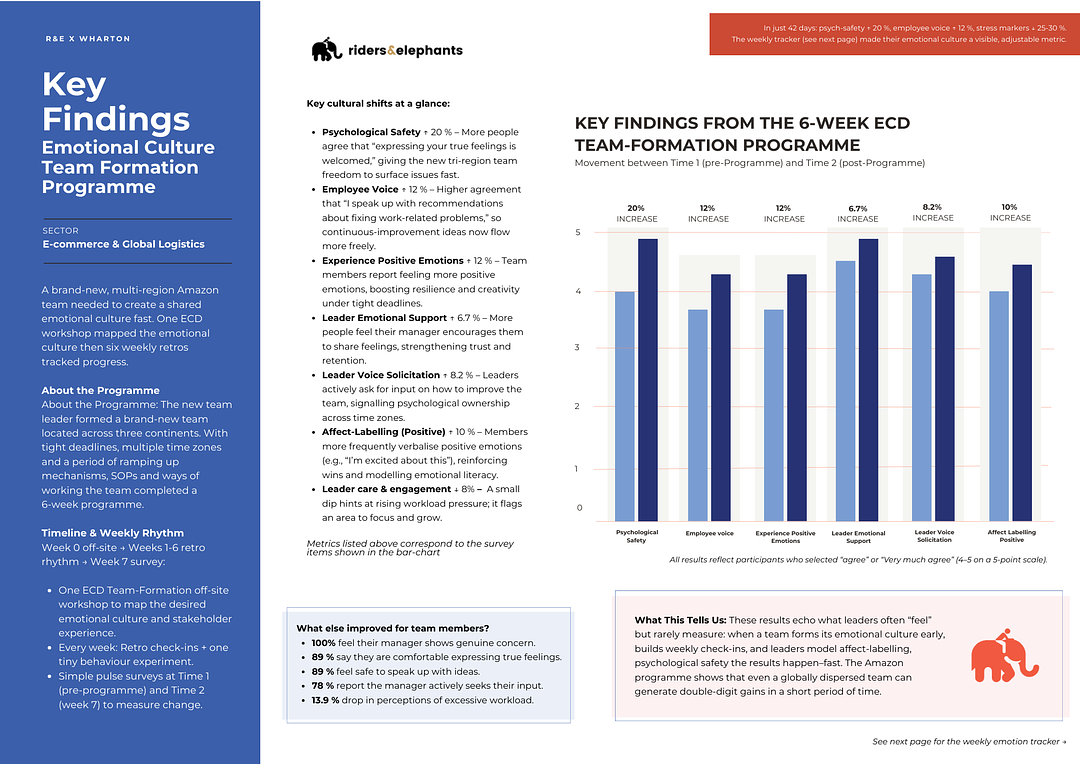
One workshop. Six weekly retros. Forty-two days. Psychological safety rose from 58% to 78%. Employee voice from 62% to 74%.

Why

Every new team gets an emotional culture. The only question is whether you design it.

When a team forms, everyone arrives with a plan, a remit and a deadline. What nobody arrives with is a shared sense of how it should feel to work together, or how the people they serve should feel working with them. So the culture forms by accident, and by the time anyone notices, it's hard to move.

This programme gives a new team the language, the ritual and the evidence to shape that culture on purpose, in the first six weeks, when it's still easy to shape. Inside the team and outward to its stakeholders.

The programme

One workshop. Six weekly retros. One review.

Name the feelings that matter, track them lightly every week inside a meeting you already have, and look back together at what moved.

Phase 01

Design

Week 0 · The workshop

Map how the team wants to feel working together and how it wants stakeholders to feel working with it. Choose six emotions to track: three desired, three undesired.

Phase 02

Retro & track

Weeks 1–6 · The rhythm

The digital Weekly Retro: two cards and a quick check-in on the team’s six feelings, then a short retro on the week. Each week the team picks one tiny behaviour experiment.

Phase 03

Reflect & review

Week 7 · The close

Six weeks of emotion data on the table. Compare the before and after. Decide which rituals the team keeps for good.

The anchor case study · Amazon

Strangers on three continents. Forty-two days later, they trusted each other enough to disagree out loud.

Susannah King was building a brand-new global team at Amazon. Tight deadlines, multiple time zones, and a period of ramping up mechanisms, processes and ways of working. The kind of team that usually takes a year to find its voice.

The challenge

A new team needed a shared culture, fast.

No shared history, no shared rituals, three continents. She wanted to test whether one workshop and a weekly ritual could build it on purpose.

What they did

Mapped both sides of the experience.

One off-site workshop to design how the team wanted to feel and how they wanted stakeholders to feel. Then six weekly retros, each with a quick check-in and one tiny behaviour experiment.

What changed

The culture became something they could see.

Tracking emotions weekly turned the culture into a metric the leader could watch and nudge in real time. Wharton measured the team before and after.
Data→Dialogue→Behaviour· repeated six times
+20%psychological safety
+12%employee voice
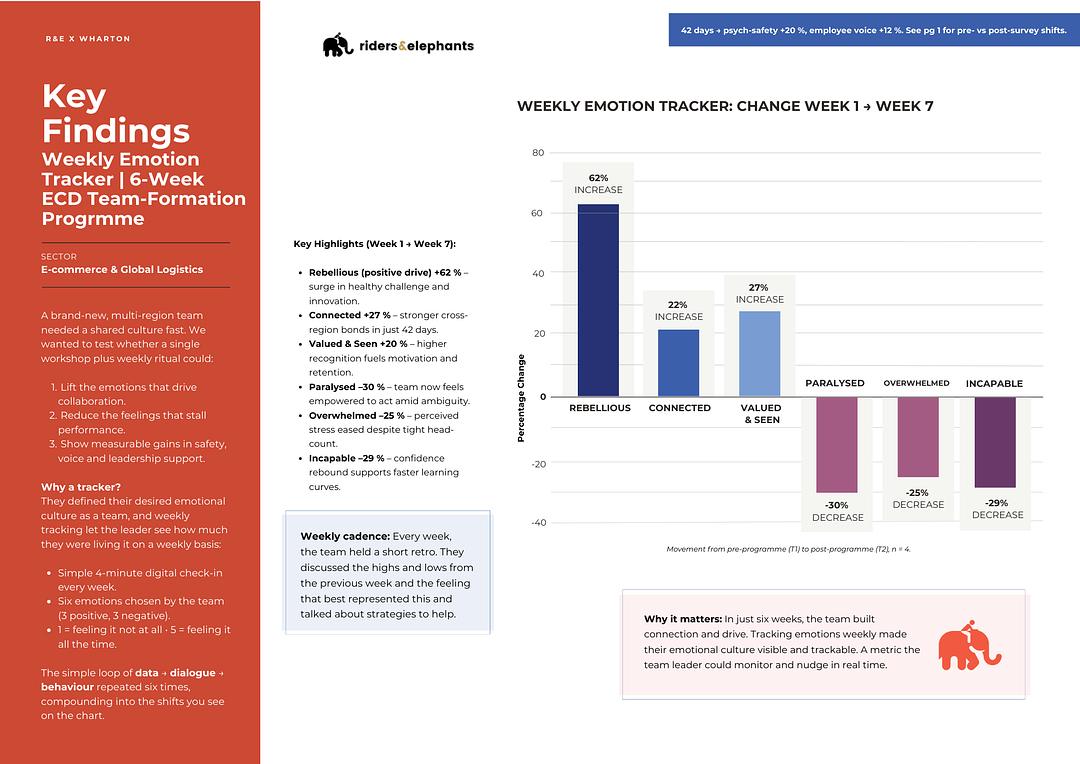
+62%positive drive (Rebellious) on the weekly tracker
−30%feeling paralysed
Before & after · % agree
Week 0
Week 7
Psychological safety
58%
→
78%
Employee voice
62%
→
74%

Also measured: positive emotions up 12%, leader voice solicitation up 8.2%, positive affect labelling up 10%, leader emotional support up 6.7%. Overwhelmed down 25%, incapable down 29%. Source: riders&elephants × The Wharton School, led with Professor Michael Parke.

See the full evidence, the team and the study.

The Emotional Evidence page holds the numbers, the method and the story behind the Amazon team, alongside every other study riders&elephants has run with Wharton.

Official Elephant Rider member badge
Members only For active Elephant Riders & Certified Partners

Read the inside story from Susannah King.

Susannah joined the community as a Guest Elephant Rider to share how she partnered with riders&elephants on the pilot, what she'd do again, and what surprised her. Sign in with your Elephant Riders account to read it.

Read the case study →
Amazon x Wharton key findings
Session by session

Six weeks, laid out.

The same shape the Amazon team ran. One workshop, one weekly rhythm, one close.

Week00

The team formation workshop.

A facilitated session, ideally off-site, for the whole team. The team maps the emotional culture they want inside the team and the experience they want to create for their stakeholders, then chooses the six emotions they'll track.

Facilitated · Whole team · Off-site
+ Dive deeper into Week 0
  • Employee experience. How do we want to feel working together, and how don't we want to feel?
  • Stakeholder experience. How do we want our stakeholders to feel working with us, and not feel?
  • Choose what to track. Agree six emotions, three desired and three undesired. These become the weekly check-in.
  • Run it with the EX & CX Design Map, or the Stakeholder Relationship Canvas if the stakeholder side is the priority.
Weeks01–06

The weekly retro.

Every week, inside an existing team meeting. On their phones, everyone picks one black card and one white card, then rates how often they felt each of the team’s six feelings. No sign-in, no names. Then a short retro: the week’s highs and lows, and what would help. Nothing new on the calendar.

Team meeting · Weekly · The digital Weekly Retro
+ Dive deeper into Weeks 1–6
  • Check in. Each person picks two cards and rates how often they felt each of the six feelings: Not often, Sometimes, Usually, Almost always or Always.
  • See the week. The leader puts the team’s picture on screen: the week in words, each feeling as a word, a card and a bar. How the tracker works.
  • Talk it through. What were the highs and lows this week? Which feeling best represented it?
  • One tiny experiment. Agree one small behaviour to try before next week.
  • The loop is data, dialogue, behaviour. Six times over, it compounds.
Week07

Reflect & review.

The closing session. Six weeks of emotion data and the before-and-after pulse survey on the table. Name what moved, what's still hard, and what the team keeps.

Facilitated · Whole team
+ Dive deeper into Week 7
  • Review the weekly trend together. Where did the desired feelings rise? Where did the undesired ones settle?
  • Compare the Week 0 and Week 7 pulse surveys on safety, voice and leader support.
  • Revisit the stakeholder side. Are we creating the experience we designed for?
  • Decide together which rituals the team carries forward.
Go deeper

Then hear it from your stakeholders themselves.

The six weeks track how the team feels and how it hopes its stakeholders feel. The next step is to ask them. These two tools carry the work into the relationship itself, so the team learns how its stakeholders actually experience working with it.

Canvas

Stakeholder Tracker Canvas

Track the perceived state of each stakeholder relationship over time, feeling by feeling. Then invite your stakeholders to complete it with you, and compare what you thought with what they feel.

Conversation guide

Stakeholder Check-in Conversation Guide

A simple 1:1 with a stakeholder to hear how they feel working with you, what’s helping and what’s getting in the way. A better conversation, and a stronger relationship, every time you use it.

Toolkit links open in the Elephant Riders community. Sign in with your Elephant Riders account.

What's included

Everything the team needs for the six weeks.

Facilitation, tools and a simple way to see the culture moving.

✓
The team formation workshop.

A facilitated session for the whole team, run by an ECD Certified Partner.

✓
The weekly retro rhythm.

A four-minute check-in and a short retro, designed to slot into a meeting the team already has.

✓
The closing reflect & review.

A facilitated session at Week 7 to look back at the data and decide what carries forward.

✓
Before & after pulse survey.

A short survey at the start and the end, so the team can see what moved.

✓
The ECD toolkit.

Emotional Culture Deck, EX & CX Design Map, Stakeholder Relationship Canvas, Weekly Retro, Reflect & Review Canvas. Plus the Stakeholder Tracker Canvas and Stakeholder Check-in Conversation Guide to go deeper.

✓
The digital Weekly Retro tracker.

A private link for the team, a room screen with a QR code, and a weekly picture for the leader, so they can see the six feelings move and nudge in real time. How it works.

Who delivers it

ECD Certified Partners. Trained in the method, endorsed by riders&elephants.

The programme is delivered by partners who have completed the ECD Certified Consultant Development Programme and have been through the peer review that lets them take it to a team.

The Partner Directory

Find a Certified Partner to run this with your team.

Browse the directory, or ask us to make an introduction.

Find a Partner →
ECD Certified Partner
Common questions

Questions new teams tend to ask.

When is the right time to start?

As early as possible. The programme is built for teams in their first weeks together, or teams that have just been reshaped, while the culture is still forming.

How much time does it take each week?

A four-minute check-in and a short retro, run inside a team meeting you already hold. The only extra time is the Week 0 workshop and the Week 7 review.

Why track stakeholder feelings as well as our own?

Because a team's culture shows up in how it treats the people it serves. The Amazon team mapped both, and the evidence suggests that when teams design both sides, culture change accelerates.

What happens with the check-in data?

Nobody is ever named. Each week everyone rates how often they felt each of the six feelings the team chose at its workshop, and can add a short note, without their name.

The team’s leader sees the team’s ratings together: the week in words, how often each feeling was felt, the cards people picked and the notes. Never who rated what, and the notes are shown in an order that can’t reveal who wrote them.

If your organisation wants a wider view, an observer sees each team’s averages week by week, and nothing else. No notes, no individual ratings. An average needs at least two people behind it, so one person’s answers can never be worked out.

Go-deeper reflections are for the person writing them. Nobody at your organisation sees them. See who sees what.

Our team is spread across time zones. Does it still work?

Yes. The Amazon team spanned three continents. The check-in is digital and the retro fits into whatever meeting the team already has.

Can we run this ourselves without a partner?

You can run the weekly retro yourselves. The workshop and the closing review are where the shift happens, and those are best held by a Certified Partner.

What's the evidence this works?

This programme was measured by riders&elephants in partnership with Professor Michael Parke at Wharton, with a new Amazon team. See the numbers on the Emotional Evidence page.

Next steps

If this feels right for your team.

Get in touch with a Certified Partner, or with us at riders&elephants, and we'll make an introduction.

Ready to design your team's culture on purpose?

Forty-two days, one rhythm, a culture you can see. The most human part of a new team, actually measured.